


Fashion street photography has become one of my favorite personal projects because it combines two things I have always loved: people and style. Unlike commercial assignments, where there is a client, a creative brief, and a specific objective, photographing people and fashion on the street is simply about observation. It is about encountering interesting people, authentic style, and those fleeting moments that exist for only a second before they disappear.
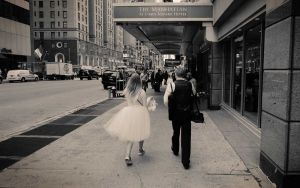
One of the reasons I love fashion street photography is New York City itself. Few places in the world offer such an extraordinary mix of people, cultures, and personal style. Every neighborhood has its own visual language, and every block feels like a different runway. Whether I’m visiting for work or simply spending time with my daughter and friends, I almost always have a camera slung over my shoulder with a long lens attached.
I don’t go to New York looking for photographs. I go to New York because I know the photographs will find me. New York rewards curiosity. A musician in Midtown, a student in Washington Park celebrating graduation, a fashionista walking on Fifth Avenue like they own it creating a style all their own.
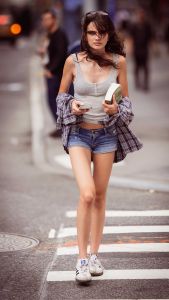
The city is constantly reinventing itself through the people who inhabit it. For me, the city is an endless fashion show where the participants aren’t models and the audience doesn’t exist. People simply live their lives, express themselves through what they wear, and move on. My job is to notice those moments and preserve them before they disappear.
People often think street photography requires getting close. The classic approach involves a small camera and a wide-angle lens, placing the photographer directly into the scene. There is a rich history of working that way, and I have enormous respect for the photographers who do it well. It simply isn’t the way I see.
I prefer to keep my distance. Not because I’m shy, and certainly not because I’m hiding, but because distance allows life to unfold naturally. People walk differently when they don’t know they’re being watched. They laugh differently. They carry themselves differently. Most importantly to me, they wear their clothes differently.
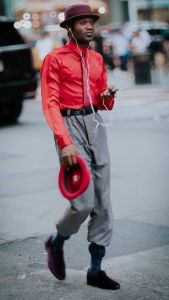
Fashion isn’t just what someone buys. It’s how they inhabit it.
On the street, I’m rarely looking for celebrities or famous faces. I’m looking for the woman whose vintage jacket somehow works perfectly with modern sneakers. The man whose tailored suit catches the afternoon light. The teenager whose confidence transforms an ordinary outfit into something memorable. The city is filled with stylists who don’t know they’re styling. My camera simply notices.
I usually work with longer lenses because they fit the way I like to photograph. They compress the background and isolate the subject, removing distractions and allowing the person to become the center of attention. The shallow depth of field creates separation, letting fashion, gesture, and personality become the story rather than the environment around them. There is another advantage. I don’t have to interrupt the moment. I can simply observe.
Street photography requires a certain kind of patience. Some photographers call it hunting, and I understand that instinct. You’re constantly searching for interesting light, compelling faces, and people with a sense of individuality. You anticipate movement and wait for all the visual elements to align.
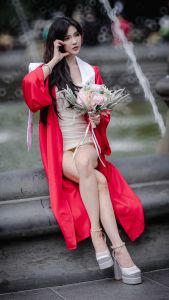
But the goal isn’t to chase people. The goal is to recognize moments. For one fraction of a second, everything comes together. The person, the light, the expression, the movement, and the style all become part of the same story. Then it’s gone.
I have learned that anticipation is often more valuable than reaction. You begin to trust your instincts. Someone will step into the sunlight. Someone else will pause to check a reflection in a store window. A stranger will turn a corner wearing exactly the right combination of confidence and elegance. The camera simply confirms what the eye has already seen.
One of the unexpected pleasures of fashion street photography comes later. People occasionally ask me who the subjects are. I almost never know. They are simply people living their lives, walking through the city, completely unaware that for a brief moment they became part of someone else’s visual memory. I think there’s something beautiful about that.
Street photography isn’t about famous people. It’s about celebrating ordinary people having extraordinary moments of individuality, confidence, and style. Every city has an endless runway. Every sidewalk offers another possibility.
My job isn’t to direct it. My job is simply to pay attention. To wait. To trust my instincts.
And when everything comes together for one perfect second, to quietly press the shutter before the moment disappears forever.
Work with David – If you’re a creative director, a marketing lead, a brand builder, an interior designer or a collector looking for work with authorship, consider this your invitation to begin the conversation. For commissioned work, contact or send a message to david@siqueiros.com
® David Siqueiros . All Rights Reserved. No reproduction rights granted or implied.


