


There are photographs you plan, and there are photographs that arrive. In fine art photography, those are often the images that endure, the ones not constructed, but discovered. Horse in Belize is one of those moments, a photograph made unexpectedly along the Caribbean shoreline, where instinct took over and the image revealed itself. Most photographs are seen. Very few are felt.
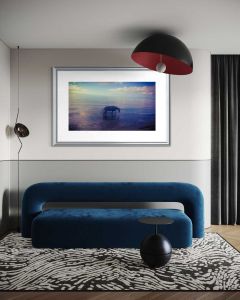
I followed the horse to the shoreline in Belize, where the scene unfolded into what would become a fine art photograph. It wasn’t pre-visualized, storyboarded, or built for a client. It revealed itself in real time, outside the structure of commercial intent. That distinction matters. While commercial photography is designed to meet expectations, fine art photography is defined by moments that exceed them. Images that exist not because they were needed, but because they could not be ignored.
I was on assignment in Belize. Commercial work, structured, purposeful, built around deliverables. On the way through town, I noticed a loose horse running down the road. Not frantic. Not wild in the cinematic sense. Just moving with intent.
I followed slowly. It led to the water. Walked straight into the sea as if it had done this before. No hesitation. No audience. Just a quiet crossing from land into something softer. I stepped out of the car, moved in carefully, and made the photograph.
The Two Worlds
Commercial photography is built on agreement.
There is a brief. A client. A defined outcome. You are solving for clarity, for message, for use. If the image works, it works because it fulfills a purpose already understood before the shutter clicks.
Fine art photography offers none of that.
There is no agreement. No predefined success. No guaranteed audience waiting on the other side. You make the work first and only later discover if it matters.
The Harder Climb
This is where most people get it wrong. They think fine art is freedom. It isn’t. It’s exposure. In commercial work, your value is validated upfront. In fine art, your value is questioned repeatedly.
You are asking someone to:
- stop
- feel
- consider
- and eventually invest
Not because they need the image, but because they cannot ignore it. That is a much steeper climb. Because the metric is not performance. It is resonance.
Why This Image Holds
This photograph does not explain itself. There is no directive. No brand message. No narrative being handed to the viewer. And yet, placed in the right space, it settles in.
Look at it in an interior. Suddenly it shifts from documentation to presence.
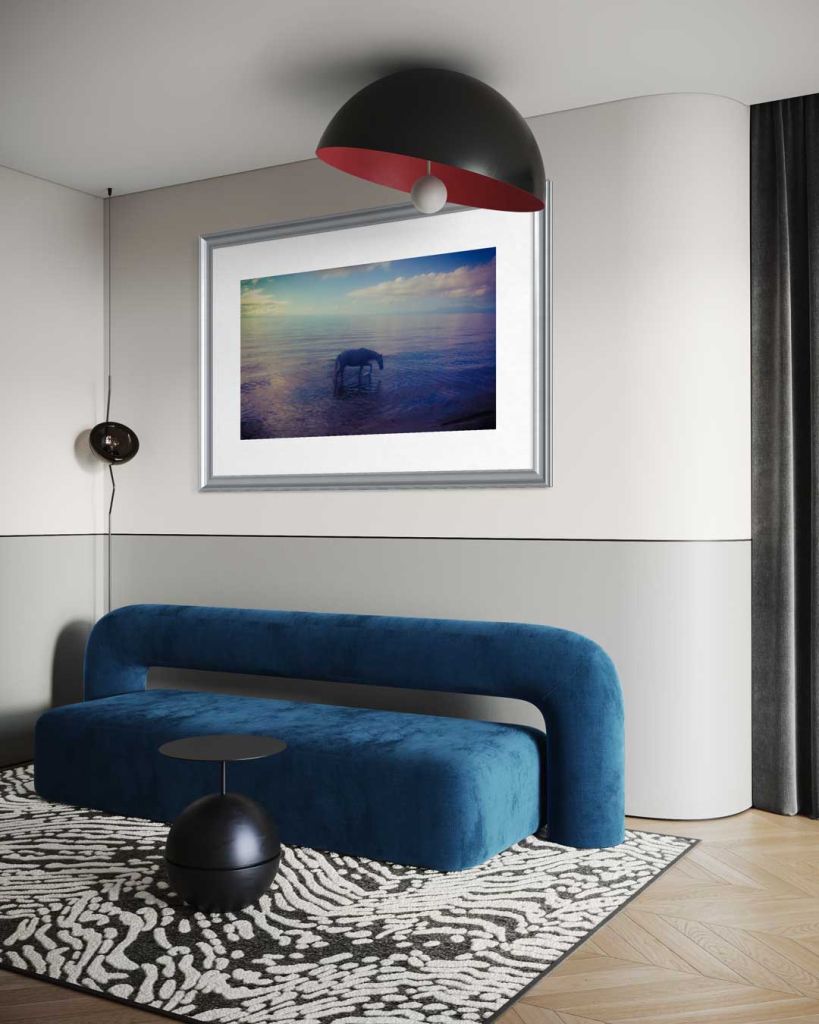
In a modern room, clean lines, sculptural furniture, controlled palettes, the photograph becomes the counterweight. Contemporary design leans toward precision and restraint, where every object is intentional and nothing is accidental.
Horse in Belize introduces what those spaces quietly need: atmosphere. The horizon softens the architecture, the color palette echoes without competing, and the solitary figure of the horse disrupts the perfection just enough to make the room feel lived in, not staged. It doesn’t fight the design it completes it.
The image brings calm movement and emotional depth into a space defined by structure, allowing modern interiors to feel not just composed, but inhabited.
It becomes:
- a pause above a sofa
- a horizon inside a room
- a quiet counterpoint to architecture
That is where fine art lives. Not on a screen. On a wall.
Work with David
If you’re a creative director, a marketing lead, a brand builder, an interior designer or a collector looking for work with authorship, consider this your invitation to begin the conversation.
For commissioned work, contact or send a message to david@siqueiros.com


